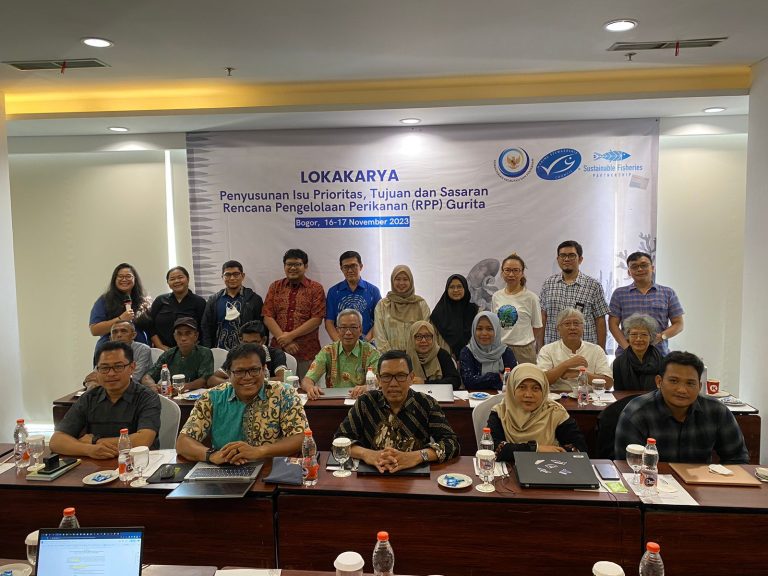
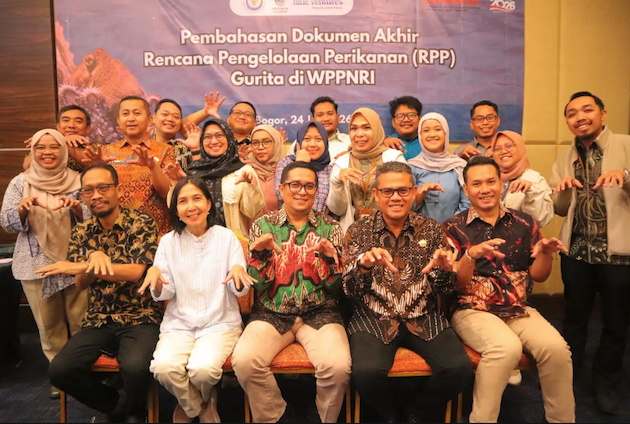
Bogor, 24 July 2026 – Efforts to advance sustainable octopus fisheries management in Indonesia took another important step forward. On Friday (24/7), representatives of the Octopus Fishery Improvement Project (FIP) Consortium—Yayasan Alam Indonesia Lestari (LINI), Yayasan Pesisir Lestari (YPL), and Japesda—participated in the final discussion of the Octopus Fisheries Management Plan (Rencana Pengelolaan Perikanan/RPP Gurita) for Indonesia’s Fisheries Management Areas (WPPNRI) in Bogor. The meeting was facilitated by the Directorate of Fish Resource Management under the Directorate General of Capture Fisheries, Ministry of Marine Affairs and Fisheries (MMAF).
The Octopus Fisheries Management Plan (RPP Gurita) is an official policy document developed to guide the government and stakeholders in managing octopus fisheries sustainably. It outlines policy directions, management strategies, and the roles of different stakeholders in conserving octopus stocks, supporting the livelihoods of small-scale fishers, and promoting responsible fishing practices.
The draft RPP Gurita has already undergone a public consultation process, which was held in Makassar, South Sulawesi, on 12 February 2026. The consultation brought together more than 100 participants representing national and local government agencies, fishing communities, the seafood industry, universities, and non-governmental organizations involved in octopus fisheries management across Indonesia.
The meeting in Bogor marked the final stage before the RPP Gurita was finalized. For many stakeholders, the document is far more than an administrative requirement. It represents a shared framework for ensuring that future octopus fisheries management is more coordinated, equitable, and sustainable, particularly in Sulawesi, one of the plan’s primary management regions.
Multi-Stakeholder Collaboration for More Responsible Fisheries Management
The initiative is supported by the Octopus FIP Consortium, which consists of nine organizations: Yayasan Alam Indonesia Lestari (LINI), currently serving as the FIP Organization Lead; Yayasan Pesisir Lestari (YPL); Japesda; Yapeka; Forkani; Foneb; Komanangi; Sustainable Fisheries Partnership (SFP); and Blue Ventures. Together, the consortium works alongside more than 20 fisher groups throughout the octopus fishing grounds of Sulawesi.
The consortium supports community-based fisheries management across five provinces in Sulawesi—North Sulawesi, Gorontalo, Central Sulawesi, Southeast Sulawesi, and South Sulawesi, reaching more than 800 octopus fishers.
The Octopus FIP was launched on 16 February 2022 through a collaboration between the Ministry of Marine Affairs and Fisheries and a range of partners to promote more responsible octopus fisheries. Through this partnership, consortium members work to strengthen co-management, encourage fishers’ participation in fisheries monitoring, and promote sustainable fishing practices.
Local Management Practices Are Already in Place
One of the key messages emerging from the discussion was that sustainable octopus management does not start from scratch. Across many coastal communities, local management practices have already been established through village regulations, community agreements, and temporary octopus fishing closures.
Experience from the field demonstrates that fishing communities have taken the initiative to safeguard octopus resources based on their local ecological and social contexts. Rather than replacing these existing efforts, the national Fisheries Management Plan is expected to strengthen and build upon them. In this way, national policy and community-led initiatives can complement one another to achieve more effective fisheries management.
The Octopus Fisheries Management Plan (RPP Gurita) as a Strategic Framework
Syahril Abdul Raup, Director of Fish Resource Management, emphasized that the development and implementation of the Octopus Fisheries Management Plan, together with its management strategy, represents an important step toward strengthening Indonesia’s fisheries governance, meeting global market expectations for sustainably managed seafood products, enhancing the competitiveness of Indonesian fisheries commodities, and safeguarding fishery resources for future generations.
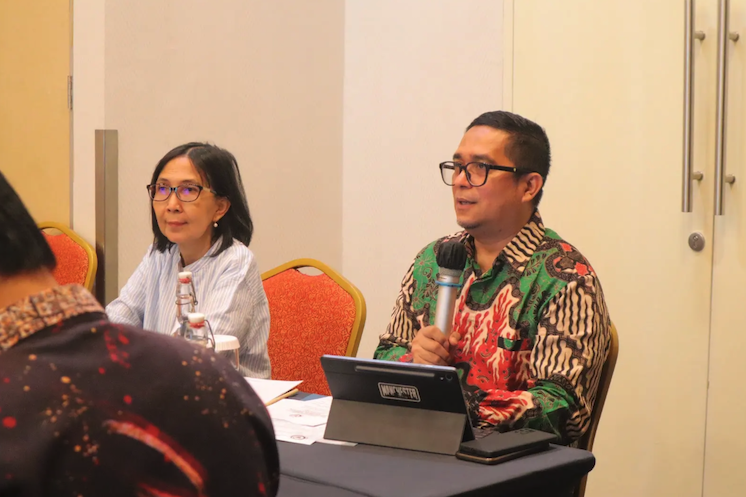
The RPP Gurita was developed as a concrete response to Indonesia’s national challenges in octopus fisheries management. It is expected to serve as the official framework for government agencies and stakeholders to conserve octopus stocks, sustain the livelihoods of small-scale fishers, and promote fair and responsible fisheries governance. Its completion therefore represents a critical milestone before the document can be formally adopted.
Preparation of the RPP Gurita began in March 2022 and has progressed through a comprehensive process, including project initiation, data collection, technical assessments, data validation, drafting, and public consultation. The development process has involved government agencies, researchers, academics, industry representatives, fishing communities, civil society organizations, and MMAF’s development partners.
During the Bogor meeting, discussions focused on incorporating feedback from the February 2026 public consultation while reviewing the document’s legal and policy framework together with the Legal Bureau of MMAF’s Secretariat General. This review forms one of the final steps before the document can be formally endorsed.
“The RPP Gurita needs to be finalized and officially adopted as soon as possible because it will serve as the foundation for future octopus management strategies for both the seafood industry and fishing communities. At the same time, we recognize that several local management initiatives are already being implemented through village regulations and community-based resource management efforts,” said Dessy, Octopus FIP Lead.
Throughout the final review process, participants emphasized that the RPP Gurita must gain strong legitimacy through thorough discussion and broad stakeholder engagement. They also highlighted the importance of aligning its structure with existing fisheries management plans to ensure consistency in both format and substance.
Addressing Management Challenges and Market Expectations
Octopus is a high-value fisheries commodity that plays a significant role in supporting the livelihoods of coastal communities through both domestic and export markets. As international attention to sustainable seafood continues to grow, strengthening sustainable fishing practices, improving fisheries data collection systems, and reinforcing local fisheries governance have become increasingly important objectives of the Octopus Fisheries Management Plan.
The RPP Gurita has been developed using the Ecosystem Approach to Fisheries Management (EAFM) framework, following the procedures established under Marine and Fisheries Ministerial Regulation No. 22 of 2021. The document also incorporates customary law, local knowledge, and meaningful community participation as integral components of sustainable octopus fisheries management.
LINI’s Commitment to Sustainable Octopus Fisheries
Through its role in the Octopus FIP Consortium, LINI reaffirms its commitment to supporting multi-stakeholder collaboration in advancing sustainable octopus fisheries management. For LINI, this process is important not only for strengthening fisheries governance at the national level but also for ensuring that the knowledge, experiences, and good practices of coastal communities continue to inform future management policies.
These collaborative efforts are expected to contribute not only to the conservation of Indonesia’s marine resources but also to improving the livelihoods and resilience of coastal communities that depend on octopus fisheries.
By Retno K Ningrum and Dessy Anggraeni