The Director of Yayasan Alam Indonesia Lestari (LINI), Eveline Kurniati, was invited to share LINI’s experience at the Regional NGO Cooperation Forum for Sustainable Coastal Community 2026 in Haikou, Hainan, China. The forum was followed by the Beigang Community Workshop, providing an opportunity for further knowledge exchange and collaboration on sustainable coastal community development.
Organized by the China Blue Sustainability Institute, supported by Partnerships for Community Development (PCD), and in strategic partnership with the Asia Academy of Philanthropy, the forum brought together more than 60 representatives from nonprofit organizations, research institutions, supporting agencies, and coastal communities.
Putting Communities at the Centre of Conservation
For LINI, conservation is not only about restoring ecosystems. It is also about creating the conditions for communities to manage their resources, adapt to changing circumstances, and build secure livelihoods.
At the forum, Eveline shared LINI’s experience in Les Village, North Bali, as an example of how long-term community engagement can contribute to both ecological recovery and livelihood transformation. The story of Les is a story of change. The community moved from practices that placed pressure on coastal ecosystems towards becoming active stewards of their marine resources. This transformation did not happen overnight. It was built through nearly two decades of partnership, continuous learning, training, and community empowerment.
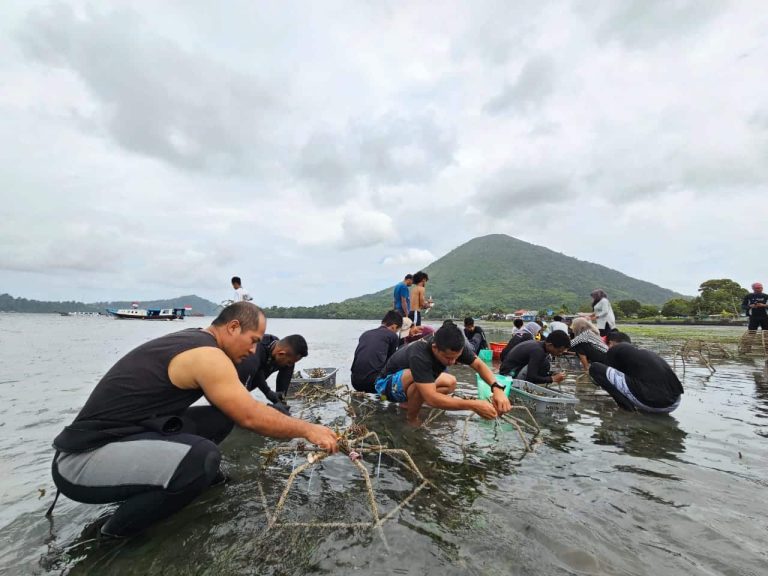
Over time, fishers strengthened their understanding of the connection between a healthy ocean and their own food security and livelihoods. Through collaborative reef restoration activities, community members learned to construct, deploy, and monitor artificial reefs themselves. After 16 years of restoration, the results have included improvements in coral cover and the return of fish and other marine life. As tourism expanded across northern Bali, the restored marine environment also opened new economic opportunities. Community members began to connect their recovering marine resources with dive and snorkel tourism, creating an additional source of income alongside fishing. For LINI, this experience demonstrates that conservation can create a ripple effect: restoring ecosystems while also creating opportunities for communities to strengthen their livelihoods.
Building Resilience Beyond Conservation
The experience in Les also highlights an increasingly important reality for coastal communities: environmental and economic challenges cannot be addressed separately. Fishing households are facing increasingly unpredictable seasons, rising fuel costs, and other pressures that can make dependence on a single source of income risky. In this context, livelihood diversification becomes an important part of building resilience.
The Les experience shows how ecosystem restoration, community capacity building, and economic diversification can become interconnected. What started as an effort to restore coastal ecosystems gradually created opportunities for communities to participate in new, nature-based economic activities. However, there is no rigid formula for this process. Every coastal community has different resources, histories, challenges, and aspirations. LINI therefore emphasizes the importance of listening to local needs, creating space for dialogue, building trust, and co-designing solutions with communities rather than applying a one-size-fits-all model.
The same principle can be seen across LINI’s other project locations, including Banggai and Selayar, where women’s groups are developing small businesses based on local resources and opportunities. For LINI, the next step is to strengthen these community-run micro-enterprises so that they can grow into more independent and sustainable livelihood opportunities over the long term.
Learning from Beigang Village
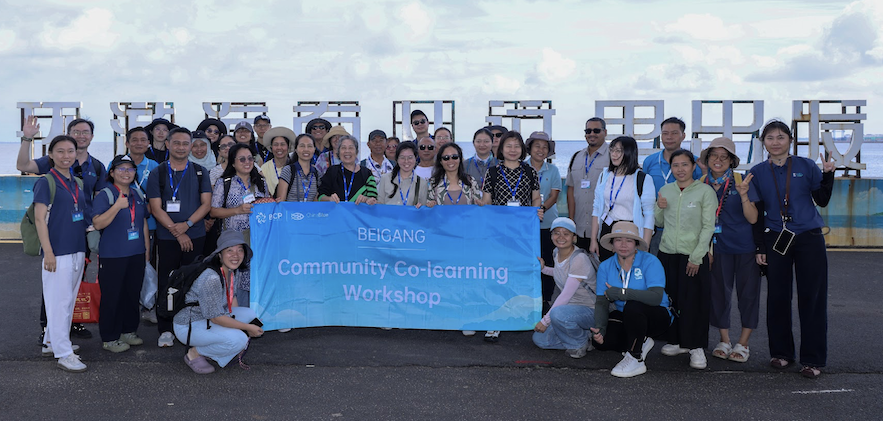
The forum was not only an opportunity for LINI to share its own experience. The workshop programme also provided participants with the opportunity to learn directly from communities in Hainan.
The visit to Beigang Village gave participants an opportunity to learn about the community’s development journey, current challenges, and future aspirations. The experience highlighted how coastal communities continuously adapt to changes in the environment, economy, infrastructure, markets, and social conditions.
From the early 2000s to around 2014, marine aquaculture and fish farming expanded rapidly in Beigang, creating income opportunities for many households, including women. However, the sector also brought risks such as disease, high feed costs, unstable markets, typhoons, and labour pressures. In 2014, Super Typhoon Rammasun caused major destruction, prompting some families to reduce or leave fish farming. The opening of the Haiwen Bridge in 2021 brought another major shift, stimulating tourism and the growth of homestays, restaurants, and other businesses. Today, Beigang’s economy combines aquaculture, tourism, and emerging green jobs such as ecological patrols and environmental education, while also facing challenges related to waste, traffic, natural resource pressures, and competition. A key lesson from Beigang was that livelihood resilience is not simply about diversifying income, but about understanding how economic activities, environmental pressures, infrastructure, and community aspirations interact over time.
This experience strongly resonates with LINI’s work in Indonesia, where coastal communities are also navigating rapid changes. It reinforces LINI’s commitment to long-term accompaniment and community-led approaches, where communities actively identify challenges, manage local resources, and shape solutions that reflect their own priorities and circumstances. The workshop also highlighted the value of co-creation and co-recommendation, bringing different perspectives together to strengthen locally driven development.
Sharing, Learning and Building Regional Connections
For LINI, participation in the Regional NGO Cooperation Forum was therefore a two-way learning process. LINI shared lessons from nearly two decades of working with coastal communities in Indonesia, particularly the experience of connecting ecosystem restoration, local stewardship, and livelihood diversification. At the same time, the organisation gained new perspectives from communities and partners working in different social, economic, and environmental contexts across Asia.
The experience reaffirmed a core principle of LINI’s work: healthy coastal ecosystems and resilient communities are deeply interconnected.
Building resilience requires more than restoring reefs, protecting fisheries, or developing livelihoods independently. It requires strengthening the relationship between communities and their environment while creating opportunities for people to adapt to change and shape their own future.
As coastal communities across the region face increasingly complex challenges, spaces for exchange such as this forum become important. By sharing experiences, learning across contexts, and building partnerships, organisations can move closer to developing approaches that are locally rooted while also contributing to a broader regional movement for sustainable and resilient coastal communities.
For LINI, the journey continues, not simply to replicate models, but to keep learning with communities, adapting together, and creating pathways toward healthier oceans and more resilient coastal livelihoods.
By Retno K. Ningrum