How can an artificial structure placed on the seafloor transform into a thriving home for corals, fish, and countless other marine species?
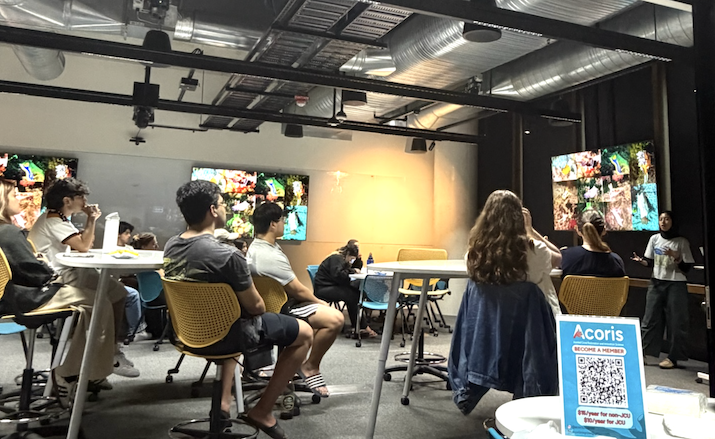
This question captured the attention of students and researchers attending Reef Talk at James Cook University (JCU), Australia, on June 18, 2026. During the event organized by ACORIS Club (Applied Coral Restoration and Innovation Science), Ryannyka, a JCU master’s student and LINI’s Research and Education Manager, shared the story of more than 15 years of coral reef restoration efforts carried out alongside coastal communities in North Bali.
Around 30 participants, including Marine Biology and Marine Science students, researchers, and local communities, attended the session. They learned how restoration initiatives launched by LINI in 2010 have generated tangible benefits for both marine ecosystems and coastal communities.
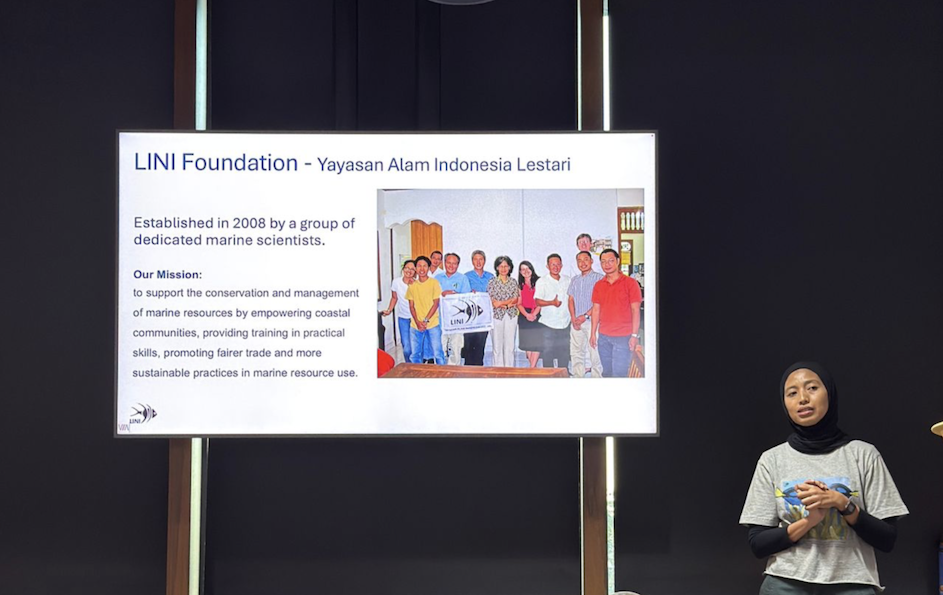
From North Bali to Townsville, Australia
This opportunity began when Ryannyka, a LINI staff member currently pursuing her master’s degree at James Cook University, met several members of the ACORIS Club during the organization’s launch earlier this year.
During their conversation, Ryannyka introduced LINI and its various programs, including its coral reef restoration and rehabilitation initiatives in North Bali. The story of how LINI collaborates with coastal communities in Les Village to restore coral reefs sparked significant interest among ACORIS members. This eventually led to an invitation for LINI to present at Reef Talk, a discussion forum regularly organized by ACORIS Club to explore issues related to coral reefs and marine ecosystem restoration.
A Story That Began with Degraded Coral Reefs
During the presentation, Ryannyka shared the background behind LINI’s coral reef restoration program in North Bali—a response to severe pressures caused by destructive fishing practices.
Until the early 2000s, the use of chemicals such as potassium cyanide to capture reef fish and ornamental fish was still occurring in several coastal areas. Although illegal, cyanide fishing persisted because it enabled fishers to catch live fish that commanded high market prices.
The environmental consequences, however, were devastating. Cyanide exposure killed coral colonies and reduced the reefs’ natural ability to recover. As habitat quality declined, populations of reef fish and other marine organisms were also affected.
In response to these challenges, LINI began working with coastal communities in Les Village, Buleleng Regency, North Bali, to develop solutions that could restore marine ecosystems while still addressing the economic needs of people who depend on coastal resources for their livelihoods.
Building New Habitats Together with the Community
Since 2010, LINI has been developing community-based coral reef restoration and rehabilitation programs. One of its key approaches is the deployment of artificial reef structures designed to support habitat recovery.
Rather than simply placing structures on the seafloor, the artificial reef design is developed through a science-based approach and co-designed with local communities.
The first structures developed were Shrimp Pot, Fish Dome and Roti Buaya. Both were designed to mimic the complexity of natural coral reefs, providing shelter for marine organisms while supporting the natural recruitment of corals, fish, and other reef-associated species.
As the program evolved, LINI also developed additional structures, including Shrimp Pots, Hexagons, and underwater statues. To date, LINI has deployed 459 Fish Domes, 1.570 Roti Buaya, 1.398 Shrimp Pots, 23 Underwater Statues, and 90 Hexagon structures
However, the true strength of the program lies not only in the design and the amount of the structures but also in the active involvement of local communities throughout every stage of the implementation.
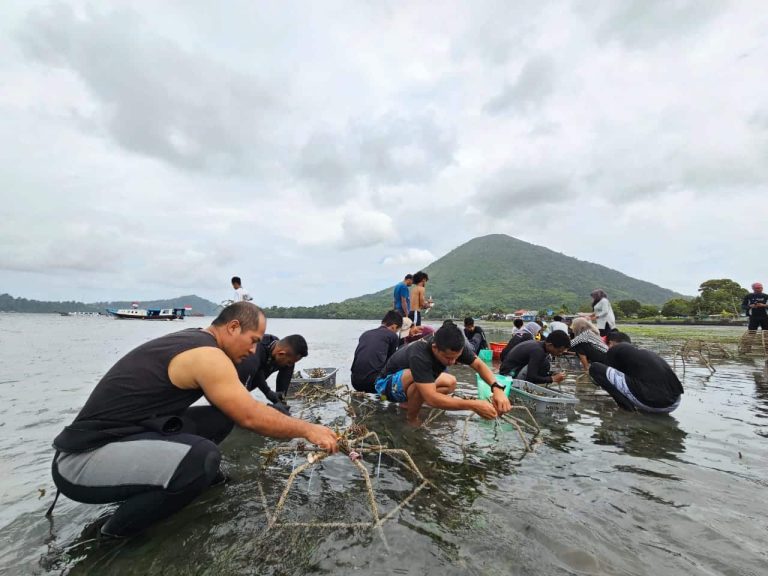
Community members participate in building, deploying, monitoring, and protecting artificial reef clusters. Through this involvement, they gain alternative sources of income from tourism and sustainable ornamental fish fisheries, while also increasing their knowledge and awareness of coral reef conservation.
Artificial Reefs That Became New Ecosystems
“The results of more than 15 years of restoration work were what fascinated the audience the most. Seeing the natural growth of corals and the abundance of associated marine life on these artificial reef structures was truly inspiring for them,” said Ryannyka.
What began as concrete structures has now transformed into living habitats covered by corals, sponges, tunicates, algae, and other benthic organisms. Over time, these organisms have grown and spread until they cover nearly the entire surface of the structures.
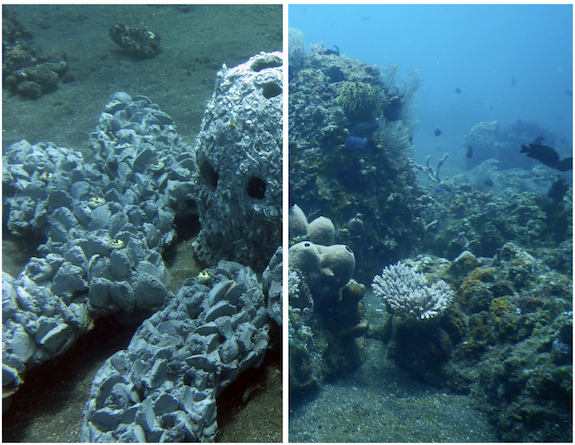
To date, 106 coral species have been recorded growing naturally on LINI’s artificial reefs. Even more remarkable is the presence of Acropora suharsonoi, an endemic Indonesian coral species classified as threatened and long absent from the area. The biodiversity extends far beyond corals. Monitoring efforts have documented at least 132 reef fish species utilizing the artificial reefs as habitat.
The Fish Dome provides a safe refuge for fish during strong currents. Squid eggs have been found attached to its surface, while octopuses are frequently observed hiding beneath the Roti Buaya structures.
Over the years, these artificial reefs have become underwater oases, demonstrating how ecosystem recovery can occur when suitable habitat is made available.
Bringing the Spirit of North Bali to Other Locations
One of the key lessons shared during Reef Talk was that every location presents unique challenges. The approaches that have proven successful in Les Village and throughout Buleleng may not be directly transferable to Australia or other regions. However, the underlying principle remains the same: involving local communities as part of the solution for the sustaining restoration program.
The lessons learned in North Bali have already inspired similar initiatives elsewhere in Indonesia. In the Banggai Islands, the approach has been adapted to support habitat recovery for the Banggai Cardinalfish, while in the Selayar Islands it has been applied to support sustainable traditional octopus fisheries.
For Ryannyka, this was the central message she hoped to bring from North Bali to Australia.
“We hope this story will open new opportunities for LINI and help bring greater international recognition to the work that has been accomplished alongside coastal communities. We also hope that the experiences from North Bali can inspire other locations to develop restoration approaches that suit their own communities and ecosystems.”
What began as an effort to restore degraded coral reefs in Les Village has grown into a story that crosses international borders. It serves as a reminder that ecosystem restoration requires time, patience, and collaboration—but the results can revive marine ecosystems while creating new opportunities for the communities that protect them.
By Retno K Ningrum and Ryannyka Dwi